
Jae-Hyuk Yu
Professor of Bacteriology
Fungi and Mycotoxins
Detoxification of Mycotoxins
Development of Broad-Spectrum Antimicrobials
Molecular Genetics of Fungal Biology
(608) 262-4696
3155 Microbial Sciences Building
- Milton T Drott, Yen-Wen Wang, E Anne Hatmaker, Nayanna M Mercado-Soto, J Mitch Elmore, Dianiris Luciano-Rosaro, Jae-Hyuk Yu, Antonis Rokas, John G Gibbons, Anna Huttenlocher, Kunlong Yang, Nancy P Keller IMA fungus
- Chenchen Guo, Liya Wang, Wen Tang, Jae-Hyuk Yu, Xiaoyu Li, Zhiqiang Liu Fungal biology
- Ye-Eun Son, He-Jin Cho, Jae-Hyuk Yu, Hee-Soo Park Journal of microbiology and biotechnology
- Wanping Chen, Ye-Eun Son, He-Jin Cho, Yonghua Wang, Hee-Soo Park, Jae-Hyuk Yu Microbiology and molecular biology reviews : MMBR
- Colin O McCarthy, Dasol Choi, Alissa A Nolden, Eric A Decker, Jae-Hyuk Yu, John G Gibbons Frontiers in fungal biology
- Márton Miskei, Sandugash Ibragimova, Beatrix Kocsis, Tibor Nagy, Hee-Soo Park, Tamás Emri, Jae-Hyuk Yu, Éva Leiter, István Pócsi Cells
- Milton T Drott, Yen-Wen Wang, E Anne Hatmaker, Nayanna M Mercado-Soto, J Mitch Elmore, Dianiris Luciano-Rosaro, Jae-Hyuk Yu, Antonis Rokas, John G Gibbons, Anna Huttenlocher, Kunlong Yang, Nancy P Keller bioRxiv : the preprint server for biology
- Jinhong Wang, Shuangzhen Zhou, Ying Zhang, Shaoyuan Lin, Jae-Hyuk Yu, Zhiqiang Liu, Xiaoyu Li Phytopathology
- Dasol Choi, Xingrui Fan, Hee-Soo Park, Jae-Hyuk Yu Scientific reports
- Dasol Choi, Xingrui Fan, Jae-Hyuk Yu Toxins
- Heungyun Moon, Mi-Kyung Lee, Junha Shin, Sung Chul Park, Julio C Rivera Vazquez, Daniel Amador-Noguez, Nancy P Keller, Hee-Soo Park, Kap-Hoon Han, Jae-Hyuk Yu mBio
- Ye-Eun Son, Kyu-Hyun Kim, He-Jin Cho, Jae-Hyuk Yu, Hee-Soo Park mSphere
- Seong-Hwan Jeong, He-Jin Cho, Jae-Hyuk Yu, Hee-Moon Park, Hee-Soo Park Journal of microbiology (Seoul, Korea)
- Ahmad Alshannaq, Morgan Henning, Jonah Dixon, Colleen Riley, Dasol Choi, Jae-Hyuk Yu, Nasia Safdar Antibiotics (Basel, Switzerland)
- Kimberly L Acevedo, Elizabeth Eaton, Julia Leite, Shu Zhao, Katherine Chacon-Vargas, Colin M McCarthy, Dasol Choi, Samuel O'Donnell, Emile Gluck-Thaler, Jae-Hyuk Yu, John G Gibbons Genome biology and evolution
- Maryam Ajmal, Aneela Nijabat, Iqra Sajjad, Syda Zahra Haider, Wendy Bedale, Jae-Hyuk Yu, Muhammad Anwer Shah, Celestin Ukozehasi, Maha Abdullah Alwaili, Amr Elkelish Scientific reports
- Zepeng Tu, Dasol Choi, Yuxing Chen, Jae-Hyuk Yu, TuAnh N Huynh Journal of dairy science
- Hye-Min Park, Ye-Eun Son, He-Jin Cho, Jae-Hyuk Yu, Hee-Soo Park Journal of microbiology and biotechnology
- Dasol Choi, Ahmad F Alshannaq, Yohan Bok, Jae-Hyuk Yu Microbiology spectrum
- Christopher P Mattison, Rebecca A Dupre, Kristen Clermont, John G Gibbons, Jae-Hyuk Yu Heliyon
- Dasol Choi, Ahmad F Alshannaq, Jae-Hyuk Yu PNAS nexus
- Dasol Choi, Wendy Bedale, Suraj Chetty, Jae-Hyuk Yu Comprehensive reviews in food science and food safety
- Wanping Chen, Ye-Eun Son, He-Jin Cho, Dasol Choi, Hee-Soo Park, Jae-Hyuk Yu Microbiology spectrum
- Jiao Pan, Xinyu Yang, Cuiting Hu, Tongtong Fu, Xiuyan Zhang, Zijun Liu, Yu Wang, Fengyu Zhang, Xiaoyuan He, Jae-Hyuk Yu Microbiology spectrum
- Jae-Yoon Kwon, Young-Ho Choi, Min-Woo Lee, Jae-Hyuk Yu, Kwang-Soo Shin Cells
- Ye-Eun Son, Jae-Hyuk Yu, Hee-Soo Park mBio
- Ildikó Vig, Zsigmond Benkő, Barnabás Cs Gila, Zoltán Palczert, Ágnes Jakab, Fruzsina Nagy, Márton Miskei, Mi-Kyung Lee, Jae-Hyuk Yu, István Pócsi, Tamás Emri Microbiology spectrum
- Seo-Yeong Jang, Ye-Eun Son, Dong-Soon Oh, Kap-Hoon Han, Jae-Hyuk Yu, Hee-Soo Park Journal of microbiology and biotechnology
- Ye-Eun Son, Jae-Hyuk Yu, Hee-Soo Park Cells
- Heungyun Moon, Mi-Kyung Lee, Ilhan Bok, Jin Woo Bok, Nancy P Keller, Jae-Hyuk Yu Microbiology spectrum
- Beatrix Kocsis, Mi-Kyung Lee, Károly Antal, Jae-Hyuk Yu, István Pócsi, Éva Leiter, Tamás Emri Cells
- Young-Ho Choi, Sung-Hun Park, Sung-Su Kim, Min-Woo Lee, Jae-Hyuk Yu, Kwang-Soo Shin International journal of molecular sciences
- Heungyun Moon, Kap-Hoon Han, Jae-Hyuk Yu Cells
- Xiaoyu Li, Yanxia Zhao, Heungyun Moon, Jieyin Lim, Hee-Soo Park, Zhiqiang Liu, Jae-Hyuk Yu Cells
- Maryam Ajmal, Wendy Bedale, Abida Akram, Jae-Hyuk Yu Toxins
- Beatrix Kocsis, Mi-Kyung Lee, Jae-Hyuk Yu, Tibor Nagy, Lajos Daróczi, Gyula Batta, István Pócsi, Éva Leiter Frontiers in microbiology
- He-Jin Cho, Sung-Hun Son, Wanping Chen, Ye-Eun Son, Inhyung Lee, Jae-Hyuk Yu, Hee-Soo Park Cells
- Yanxia Zhao, Mi-Kyung Lee, Jieyin Lim, Heungyun Moon, Hee-Soo Park, Weifa Zheng, Jae-Hyuk Yu Fungal biology
- Wanping Chen, Xucong Lv, Van-Tuan Tran, Jun-Ichi Maruyama, Kap-Hoon Han, Jae-Hyuk Yu Frontiers in microbiology
- Maryam Ajmal, Ahmad F Alshannaq, Heungyun Moon, Dasol Choi, Abida Akram, Brian Gagosh Nayyar, John G Gibbons, Jae-Hyuk Yu Toxins
- Tamás Emri, Barnabás Gila, Károly Antal, Fanni Fekete, Heungyun Moon, Jae-Hyuk Yu, István Pócsi Microorganisms
- Katherine Chacón-Vargas, Colin O McCarthy, Dasol Choi, Long Wang, Jae-Hyuk Yu, John G Gibbons Frontiers in microbiology
- Yanxia Zhao, Mi-Kyung Lee, Jieyin Lim, Heungyun Moon, Hee-Soo Park, Weifa Zheng, Jae-Hyuk Yu Journal of microbiology (Seoul, Korea)
- Lili Jia, Jae-Hyuk Yu, Fusheng Chen, Wanping Chen Fungal genetics and biology : FG & B
- Yong-Ho Choi, Sang-Cheol Jun, Min-Woo Lee, Jae-Hyuk Yu, Kwang-Soo Shin International journal of molecular sciences
- Barnabás Csaba Gila, Heungyun Moon, Károly Antal, Márton Hajdu, Réka Kovács, Andrea P Jónás, Tünde Pusztahelyi, Jae-Hyuk Yu, István Pócsi, Tamás Emri Applied and environmental microbiology
- Ming-Yueh Wu, Matthew E Mead, Mi-Kyung Lee, George F Neuhaus, Donovon A Adpressa, Julia I Martien, Ye-Eun Son, Heungyun Moon, Daniel Amador-Noguez, Kap-Hoon Han, Antonis Rokas, Sandra Loesgen, Jae-Hyuk Yu, Hee-Soo Park mBio
- Ahmad Alshannaq, Jae-Hyuk Yu Toxins
- Tawfiq Alsulami, Nidhi Nath, Rod Flemming, Hui Wang, Wenhui Zhou, Jae-Hyuk Yu Biosensors & bioelectronics
- Jongsun Park, Mi-Kyung Lee, Jae-Hyuk Yu, Jong-Hwa Kim, Kap-Hoon Han Mitochondrial DNA. Part B, Resources
- Jongsun Park, Mi-Kyung Lee, Jae-Hyuk Yu, Bohan Zhu, Jong-Hwa Kim, Kap-Hoon Han Mitochondrial DNA. Part B, Resources
- E Anne Hatmaker, Xiaofan Zhou, Matthew E Mead, Heungyun Moon, Jae-Hyuk Yu, Antonis Rokas Microbiology resource announcements
- Sang-Cheol Jun, Yong-Ho Choi, Min-Woo Lee, Jae-Hyuk Yu, Kwang-Soo Shin mSphere
- Hee-Soo Park, Min-Ju Kim, Jae-Hyuk Yu, Kwang-Soo Shin Pathogens (Basel, Switzerland)
- Velvet activated McrA plays a key role in cellular and metabolic development in Aspergillus nidulansMi-Kyung Lee, Ye-Eun Son, Hee-Soo Park, Ahmad Alshannaq, Kap-Hoon Han, Jae-Hyuk Yu Scientific reports
- Nokwanda Samantha Ngcobo, Zinhle Edith Chiliza, Wanping Chen, Jae-Hyuk Yu, David R Nelson, Jack A Tuszynski, Jordane Preto, Khajamohiddin Syed International journal of molecular sciences
- Fanele Cabangile Mnguni, Tiara Padayachee, Wanping Chen, Dominik Gront, Jae-Hyuk Yu, David R Nelson, Khajamohiddin Syed International journal of molecular sciences
- Imre Boczonádi, Zsófia Török, Ágnes Jakab, Gábor Kónya, Klaudia Gyurcsó, Edina Baranyai, Zoltán Szoboszlai, Boglárka Döncző, István Fábián, Éva Leiter, Mi-Kyung Lee, László Csernoch, Jae-Hyuk Yu, Zsófia Kertész, Tamás Emri, István Pócsi Journal of basic microbiology
- Ye-Eun Son, He-Jin Cho, Wanping Chen, Sung-Hun Son, Mi-Kyung Lee, Jae-Hyuk Yu, Hee-Soo Park Current genetics
- Ahmad F Alshannaq, Jae-Hyuk Yu Toxins
- Makhosazana Jabulile Khumalo, Nomfundo Nzuza, Tiara Padayachee, Wanping Chen, Jae-Hyuk Yu, David R Nelson, Khajamohiddin Syed International journal of molecular sciences
- Yanxia Zhao, Jieyin Lim, Jianyang Xu, Jae-Hyuk Yu, Weifa Zheng Molecular microbiology
- Min-Ju Kim, Mi-Kyung Lee, Huy Quang Pham, Myeong Ju Gu, Bohan Zhu, Sung-Hun Son, Dongyup Hahn, Jae-Ho Shin, Jae-Hyuk Yu, Hee-Soo Park, Kap-Hoon Han Genes
- Yong-Ho Choi, Min-Woo Lee, Olumuyiwa Ayokunle Igbalajobi, Jae-Hyuk Yu, Kwang-Soo Shin Pathogens (Basel, Switzerland)
- Hnin Phyu Lwin, Yong-Ho Choi, Min-Woo Lee, Jae-Hyuk Yu, Kwang-Soo Shin International journal of molecular sciences
- Min-Ju Kim, Won-Hee Jung, Ye-Eun Son, Jae-Hyuk Yu, Mi-Kyung Lee, Hee-Soo Park Journal of microbiology (Seoul, Korea)
- Ming Lei, Jiao Liu, Yang Fang, Yanchun Shao, Li Li, Jae-Hyuk Yu, Fusheng Chen Frontiers in microbiology
- Olufunmilayo Olukemi Akapo, Tiara Padayachee, Wanping Chen, Abidemi Paul Kappo, Jae-Hyuk Yu, David R Nelson, Khajamohiddin Syed International journal of molecular sciences
- Puleng Rosinah Syed, Wanping Chen, David R Nelson, Abidemi Paul Kappo, Jae-Hyuk Yu, Rajshekhar Karpoormath, Khajamohiddin Syed International journal of molecular sciences
- Erin M Ostrem Loss, Mi-Kyung Lee, Ming-Yueh Wu, Julia Martien, Wanping Chen, Daniel Amador-Noguez, Colin Jefcoate, Christina Remucal, Seunho Jung, Sun-Chang Kim, Jae-Hyuk Yu mBio
- Jae Min Choi, Daham Jeong, Eunae Cho, Jae-Hyuk Yu, Muhammad Nazir Tahir, Seunho Jung Polymers
- Yohan Kim, Daham Jeong, Kyeong Hui Park, Jae-Hyuk Yu, Seunho Jung Polymers
- Louisa Moshoeshoe Senate, Martin Phalane Tjatji, Kayla Pillay, Wanping Chen, Ntokozo Minenhle Zondo, Puleng Rosinah Syed, Fanele Cabangile Mnguni, Zinhle Edith Chiliza, Hans Denis Bamal, Rajshekhar Karpoormath, Thandeka Khoza, Samson Sitheni Mashele, Jonathan Michael Blackburn, Jae-Hyuk Yu, David R Nelson, Khajamohiddin Syed Scientific reports
- Young Kim, Min-Woo Lee, Sang-Cheol Jun, Yong-Ho Choi, Jae-Hyuk Yu, Kwang-Soo Shin Scientific reports
- Matthew D Rosienski, Mi-Kyung Lee, Jae-Hyuk Yu, Charles W Kaspar, John G Gibbons Microbiology resource announcements
- Bongumusa Comfort Mthethwa, Wanping Chen, Mathula Lancelot Ngwenya, Abidemi Paul Kappo, Puleng Rosinah Syed, Rajshekhar Karpoormath, Jae-Hyuk Yu, David R Nelson, Khajamohiddin Syed International journal of molecular sciences
- Ahmad F Alshannaq, John G Gibbons, Mi-Kyung Lee, Kap-Hoon Han, Seung-Beom Hong, Jae-Hyuk Yu Scientific reports
- Tae-Jin Eom, Heungyun Moon, Jae-Hyuk Yu, Hee-Soo Park Journal of microbiology (Seoul, Korea)
- Ming-Yueh Wu, Matthew E Mead, Mi-Kyung Lee, Erin M Ostrem Loss, Sun-Chang Kim, Antonis Rokas, Jae-Hyuk Yu mBio
- Erin M Ostrem Loss, Jae-Hyuk Yu Molecular microbiology
- Mathula Lancelot Ngwenya, Wanping Chen, Albert Kotze Basson, Jabulani Siyabonga Shandu, Jae-Hyuk Yu, David R Nelson, Khajamohiddin Syed International journal of molecular sciences
- Chan-Woo Park, Yesol Bak, Min-Je Kim, Ganipisetti Srinivasrao, Joonsung Hwang, Nak K Sung, Bo Yeon Kim, Jae-Hyuk Yu, Jin Tae Hong, Do-Young Yoon Frontiers in pharmacology
- Hans Denis Bamal, Wanping Chen, Samson Sitheni Mashele, David R Nelson, Abidemi Paul Kappo, Rebamang Anthony Mosa, Jae-Hyuk Yu, Jack A Tuszynski, Khajamohiddin Syed Scientific reports
- Jiao Pan, Cuiting Hu, Jae-Hyuk Yu Journal of fungi (Basel, Switzerland)
- Young Kim, In-Beom Heo, Jae-Hyuk Yu, Kwang-Soo Shin Frontiers in microbiology
- Erzsébet Orosz, Károly Antal, Zoltán Gazdag, Zsuzsa Szabó, Kap-Hoon Han, Jae-Hyuk Yu, István Pócsi, Tamás Emri International journal of genomics
- Hee-Soo Park, Sang-Cheol Jun, Kap-Hoon Han, Seung-Beom Hong, Jae-Hyuk Yu Advances in applied microbiology
- Isabel Valsecchi, Özlem Sarikaya-Bayram, Joanne Wong Sak Hoi, Laetitia Muszkieta, John Gibbons, Marie-Christine Prevost, Adeline Mallet, Jacomina Krijnse-Locker, Oumaima Ibrahim-Granet, Isabelle Mouyna, Paul Carr, Michael Bromley, Vishukumar Aimanianda, Jae-Hyuk Yu, Antonis Rokas, Gerhard H Braus, Cosmin Saveanu, Özgür Bayram, Jean Paul Latgé Molecular microbiology
- Ming-Yueh Wu, Matthew E Mead, Sun-Chang Kim, Antonis Rokas, Jae-Hyuk Yu PloS one
- Ahmad Alshannaq, Jae-Hyuk Yu International journal of environmental research and public health
- Hee-Soo Park, Mi-Kyung Lee, Sun Chang Kim, Jae-Hyuk Yu PloS one
- Mi-Kyung Lee, Hee-Soo Park, Kap-Hoon Han, Seung-Beom Hong, Jae-Hyuk Yu Fungal genetics and biology : FG & B
- Olumuyiwa Ayokunle Igbalajobi, Jae-Hyuk Yu, Kwang-Soo Shin Biochemical and biophysical research communications
- Jae Min Choi, Eunil Hahm, Kyeonghui Park, Daham Jeong, Won-Yeop Rho, Jaehi Kim, Dae Hong Jeong, Yoon-Sik Lee, Sung Ho Jhang, Hyun Jong Chung, Eunae Cho, Jae-Hyuk Yu, Bong-Hyun Jun, Seunho Jung Nanomaterials (Basel, Switzerland)
- Jae Min Choi, Kyeonghui Park, Benel Lee, Daham Jeong, Someshwar D Dindulkar, Youngjin Choi, Eunae Cho, Seyeon Park, Jae-Hyuk Yu, Seunho Jung Carbohydrate polymers
- Ronald P de Vries, Robert Riley, Ad Wiebenga, Guillermo Aguilar-Osorio, Sotiris Amillis, Cristiane Akemi Uchima, Gregor Anderluh, Mojtaba Asadollahi, Marion Askin, Kerrie Barry, Evy Battaglia, Özgür Bayram, Tiziano Benocci, Susanna A Braus-Stromeyer, Camila Caldana, David Cánovas, Gustavo C Cerqueira, Fusheng Chen, Wanping Chen, Cindy Choi, Alicia Clum, Renato Augusto Corrêa Dos Santos, André Ricardo de […]
- Mohammad Parvez, Lehlohonolo Benedict Qhanya, Ntsane Trevor Mthakathi, Ipeleng Kopano Rosinah Kgosiemang, Hans Denis Bamal, Nataraj Sekhar Pagadala, Ting Xie, Haoran Yang, Hengye Chen, Chrispian William Theron, Richie Monyaki, Seiso Caiphus Raselemane, Vuyani Salewe, Bogadi Lorato Mongale, Retshedisitswe Godfrey Matowane, Sara Mohamed Hasaan Abdalla, Wool Isaac Booi, Mari van Wyk, Dedré Olivier, Charlotte E Boucher, […]
- Mun-Gu Jung, Sung Su Kim, Jae-Hyuk Yu, Kwang-Soo Shin PloS one
- Jae Min Choi, Eunae Cho, Benel Lee, Daham Jeong, Youngjin Choi, Jae-Hyuk Yu, Seunho Jung Carbohydrate polymers
- Kwang-Soo Shin, Hee-Soo Park, Young Kim, In-Beom Heo, Young Hwan Kim, Jae-Hyuk Yu Journal of proteomics
Application of Food-Grade Fungi to Safeguard Global Food Safety
The filamentous fungus Aspergillus oryzae is a GRAS (Generally Recognized as Safe) organism that has been used for thousands of years to produce various foods, including Doen-Jang, Korean traditional liquors, miso, and sake. Growing this food-grade A. oryzae fungus in different proprietary culture media made of various food ingredients led to the development of two types of novel bioproducts, termed D-Tox™ and Natural Preservative™ (NP™). D-Tox™ is an edible culture fermentate that can effectively degrade aflatoxins (AFs; the most potent carcinogen found in nature) within various foods, herbal medicines, and oil. AF detoxification involves opening the AF lactone ring followed by decarboxylation and further fragmentation of the toxin into nontoxic substances. NP™ products are also edible food fermentates that can effectively control a broad range of food-borne pathogenic bacteria, at least 10 different MRSA strains, and the human pathogenic fungi Aspergillus fumigatus and Candida species. Due to the significant potential of these bioproducts to safeguard global food safety and serve as novel antimicrobials, various US, Korean, and international patent applications have been filed, and several industry partners are working with us. We are currently investigating the chemical and molecular nature of D-Tox™ and NP™, and are developing various application processes and commercial products.
The Promise of Safe Food for Billions
Five Things Everyone Should Know about … Mycotoxins
Molecular genetics/genomics of fungal biology
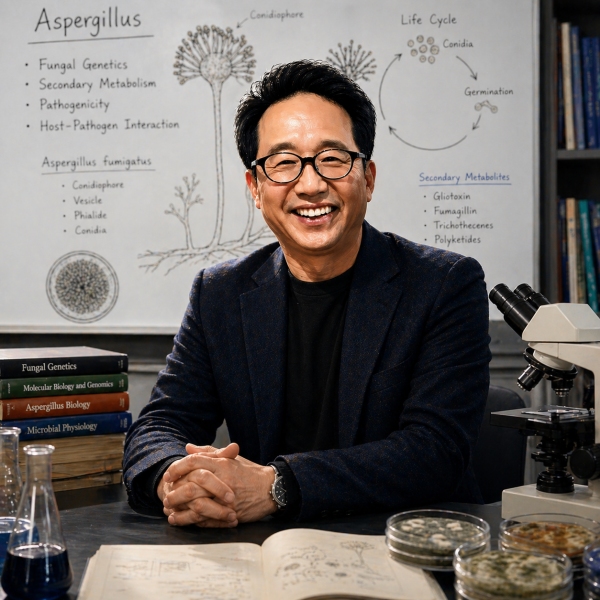
The genus Aspergillus encompasses the most common fungi in our environment. Many Aspergillus species are beneficial to humans, but they also include serious animal and plant pathogens. Moreover, most (if not all) Aspergillus species have the ability to produce one or more toxic secondary metabolites called mycotoxins. All Aspergilli produce asexual spores as the main means of dispersion and biosynthesis of certain mycotoxins is intimately related with fungal sporulation. The primary interest of my research program is to understand how fungi coordinate growth, sporulation and toxin biosynthesis employing the model fungus Aspergillus nidulans. We showed that two antagonistic regulatory pathways govern vegetative growth and sporulation in A. nidulans. Vegetative growth is primarily mediated by a heterotrimeric G protein, which stimulates fungal growth while inhibiting asexual/sexual sporulation as well as production of the carcinogenic mycotoxin sterigmatocystin. We found that the initiation, progression and completion of sporulation are directed by the balanced activities of multiple positive and negative regulators. We are further investigating the detailed molecular mechanisms regulating these fundamental biological processes via forward/reverse genetics, genomics and biochemical analyses.
Microbiology 305: Critical Analyses in Microbiology
Microbiology/Oncology 545: Topics in Biotechnology
Microbiology 810: Current Issues in Microbiology
Start and Promotion Dates
- Assistant Professor: 2000
- Associate Professor: 2006
- Full Professor: 2011
Education
B.S., Microbiology, Seoul National University, Seoul, Korea
M.S., Food Science, University of Wisconsin-Madison
Ph.D., Genetics, University of Wisconsin-Madison
Postdoctoral Research: Genetics, Texas A&M University
- Xingrui Fan – Grad Student
- Kap-Hoon Han – Honorary Associate
- Will Han – Grad Student